







































Moving a Grand Piano: The Complete Expert Guide (2026)
Moving a Grand Piano: The Expert Guide Chicago Homeowners and Musicians Actually Need
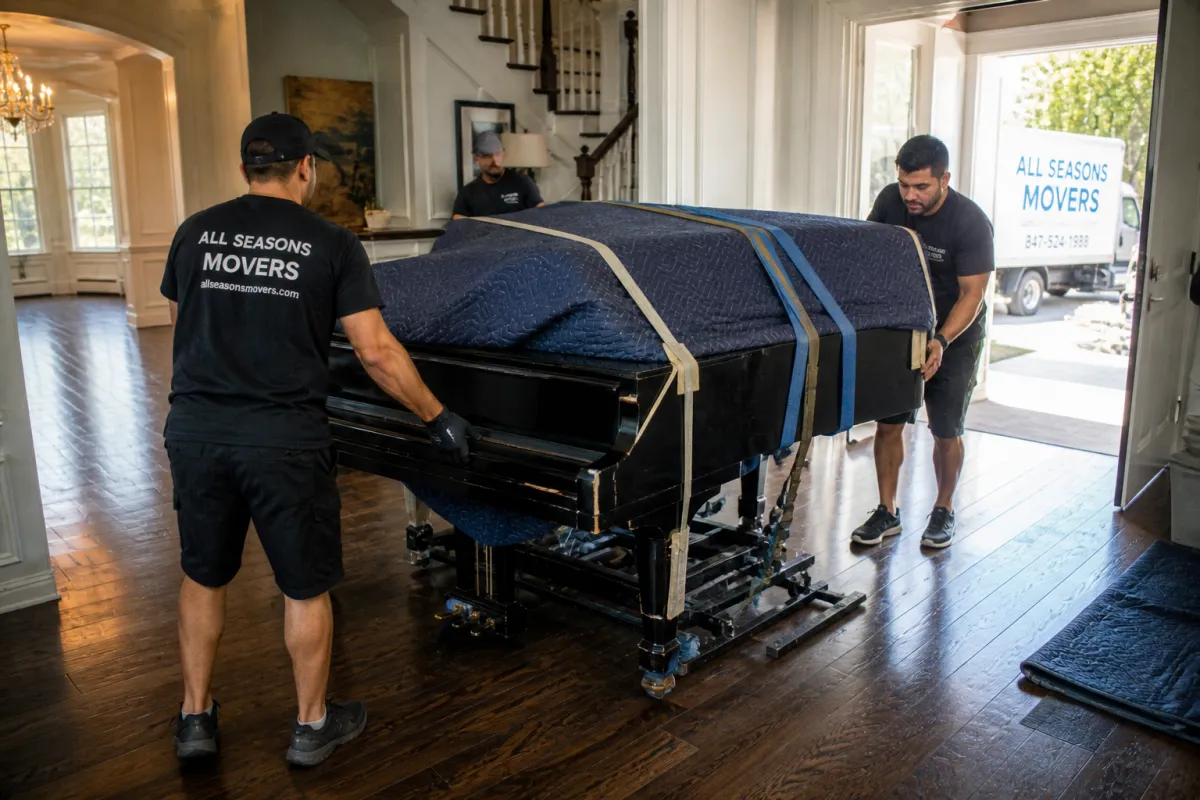
Moving a grand piano is not a moving job. It's a precision operation. Anyone who's ever watched a grand piano make its way down a narrow staircase — legs off, body on its side, four people moving in near-silence — knows exactly what we mean. One wrong angle, one slippery grip, one underestimated doorframe and you're looking at thousands of dollars in damage to an instrument that might have taken years to save for.
This guide is for people who take their grand piano seriously. We're going to cover everything — types of grands, the full disassembly and moving process, what it really costs in Chicago, how to choose the right movers, and how to protect your instrument before, during, and after the move. No fluff. Just what you need to know.
What this guide covers
The different types of grand pianos and what each one weighs
Why moving a grand piano is completely different from an upright
The full step-by-step disassembly and moving process
What moving a grand piano costs in Chicago (real numbers)
Chicago-specific challenges — walkups, weather, tight streets
How to prepare your home and your piano before the movers arrive
What happens after the move — settling, tuning, reconditioning
Questions to ask before hiring any piano mover in Chicago
Types of Grand Pianos and Why Size Changes Everything About the Move
Before anything else, your movers need to know exactly which type of grand piano they're dealing with. The size and weight affects the crew size needed, the equipment required, and ultimately the cost. Here's the breakdown:
A Steinway Model S baby grand and a Steinway Model D concert grand are both "grand pianos" — but one weighs 540 lbs and the other nearly 1,000. That difference defines everything: how many movers, what truck size, whether a skid board is enough or a lift is needed. Always give your movers the exact make, model, and approximate length before they quote you.
Why Moving a Grand Piano Is Completely Different From Moving an Upright
People who have moved an upright piano before sometimes assume moving a grand piano is "the same thing, just bigger." It's not. The challenges are fundamentally different — and underestimating them is one of the most common (and costly) mistakes we see.
The center of gravity on a grand piano shifts dramatically once the legs are removed and the body is on its side. Navigating a 700-lb flat surface through a doorframe requires extraordinary coordination — one person slightly out of sync and the whole instrument torques. This is why even experienced general movers should not attempt moving a grand piano without specific training in piano handling.
The Full Grand Piano Moving Process — Step by Step
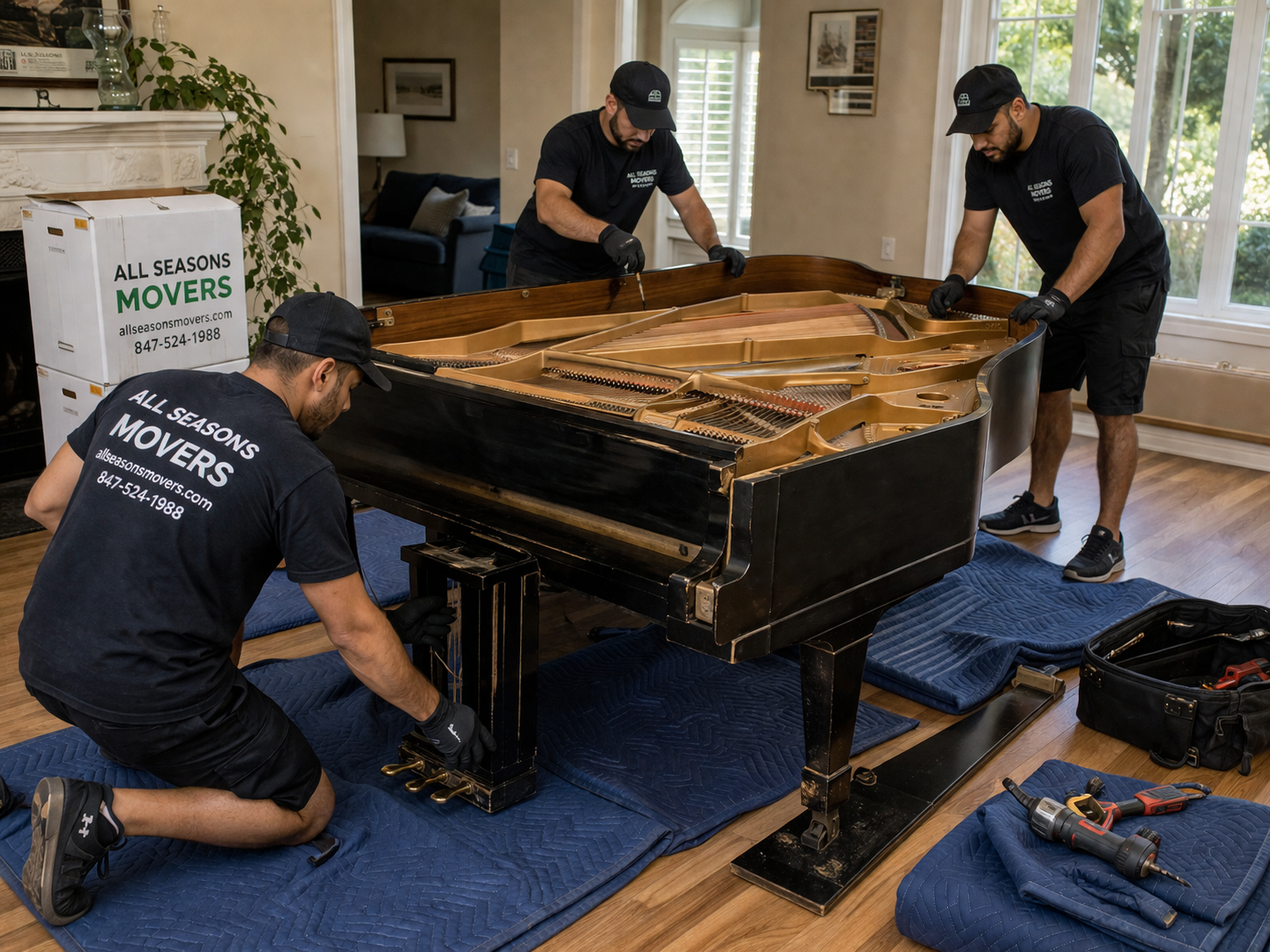
Here is exactly what a professional grand piano moving crew does, from the moment they walk through your door to the moment the piano is reassembled at its destination. Knowing this helps you verify that whoever you hire is actually doing it right.
Pre-move site survey
The crew walks both locations — origin and destination. They measure doorways (minimum 32" needed for most grands), ceiling heights on stairwells, hallway widths, elevator dimensions, and assess parking access for the truck. If any measurement is tight, they plan the solution before touching the piano.
Keyboard lid and fallboard secured
The keyboard lid (fallboard) is closed and locked or taped shut. Keys must not be allowed to shift during disassembly or transport — even small key movement can damage the key bed mechanism.
Grand lid removed and wrapped
The long lid is unhinged, wrapped in moving blankets and stretch film, and stored separately. This is typically the most scratch-prone surface on any grand piano — it must never travel leaning against other items.
Music desk and music shelf removed
These smaller pieces are removed, individually wrapped, and packed in padded boxes or blankets. They're often overlooked but easily cracked if left on during the move.
Pedal lyre disassembly
The pedal lyre (the bracket housing the sustain, sostenuto, and soft pedals) is unbolted from the underside of the piano body. This is a two-person job — one holds the lyre steady while the other removes the bolts. The lyre is then wrapped and labeled.
Leg removal — bass side first
Always the bass side (the longer, curved side) leg comes off first. Two movers hold the piano body while a third removes the leg bolt. The piano body is then carefully lowered onto padded supports — never onto the floor directly.
Remaining legs removed
With the bass side supported, the two treble-side legs are removed. The entire body is now resting on padded supports or the skid board, ready to be positioned for strapping.
Body loaded onto skid board
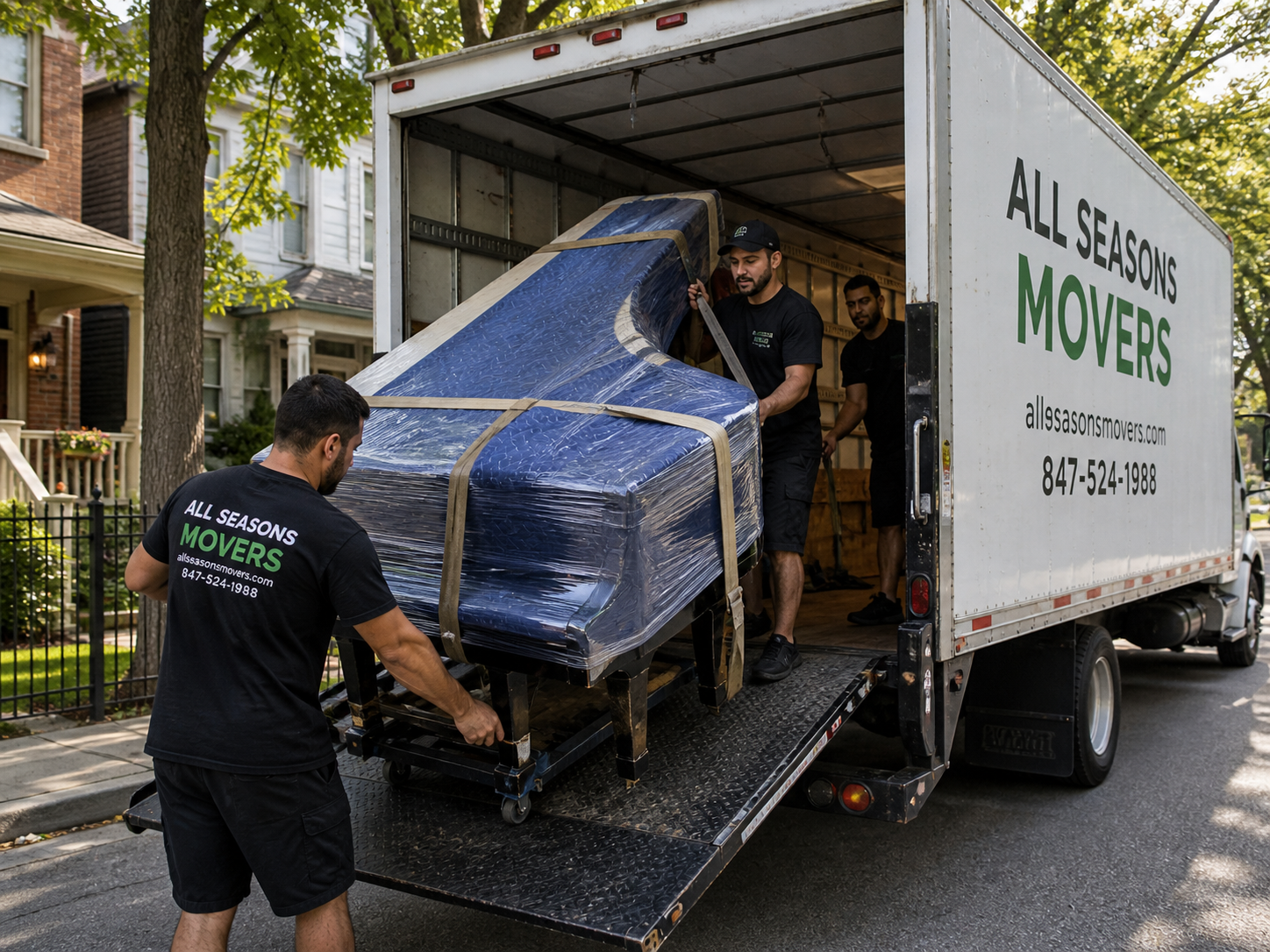
The piano body is slid or lifted onto a specialized piano skid board — a padded platform with wheels designed specifically for the weight and shape of a grand. The piano is strapped firmly to the skid, bass side down, and fully wrapped in moving blankets.
Transit and truck loading
The skid board rolls into the truck. The piano is positioned against the truck wall and strapped at multiple points. It travels bass-side down, never flat — this protects the internal soundboard and string tension from pressure damage.
Unloading and reassembly
At the destination, the entire process reverses. Legs are reattached (treble side first this time), the lyre is reinstalled, the lid and music desk are replaced, and the piano is positioned exactly where you want it before anyone leaves.
What Does Moving a Grand Piano Cost in Chicago?
Grand piano moving costs in Chicago are driven by three factors above all else — piano size, staircase access, and distance. Here are real current numbers to benchmark your quotes against:
Chicago-Specific Challenges When Moving a Grand Piano
Walkup buildings and vintage architecture
Chicago's housing stock is old — and old buildings mean narrow staircases, low ceilings, sharp turns at landings, and doorframes that were built before grand pianos became popular household items. A professional crew surveys these constraints in advance and comes equipped with stair-climbing equipment, custom ramps, or in extreme cases, window removal and crane hoisting. Yes — we've seen that more than once in Chicago's Lincoln Park and Wicker Park neighborhoods.
Chicago winters and your grand piano
Moving a grand piano in January in Chicago is a real thing — and temperature shock is a genuine concern. When a piano moves from a 70°F home into -10°F outside air and then back into a warm building, the wood expands and contracts rapidly. This can affect tuning stability, string tension, and in rare cases, cause hairline cracks in the soundboard. Professional movers handle this by minimizing outdoor exposure time and using blanket-wrapped, climate-appropriate vehicles. Never let a mover leave your piano in an unheated truck overnight in a Chicago winter.
Parking and street access in Chicago
Chicago's permit parking, narrow side streets, and no-stopping zones create logistical headaches for piano moves. A good Chicago piano moving company will either pull parking permits in advance or know the city's loading zone regulations by neighborhood. Always ask your mover what their plan is for truck access — "we'll figure it out on the day" is not an acceptable answer when you're moving a $15,000 instrument.
How to Prepare for Moving a Grand Piano — Your Pre-Move Checklist
Your job before the movers arrive is to make their job possible. Here's what to do in the days before moving a grand piano:
Measure every doorway, hallway, and stairwell at both locations. Write down the exact measurements — width, height, and for stairs, the width at the tightest point of the turn. Share these with your movers before moving day, not on the morning of.
Clear a path from the piano to the exit that is at minimum 36" wide. Move rugs entirely — not to the side, entirely off the path. Rugs under dollies are how accidents happen.
Know your building's elevator dimensions if relevant. Many Chicago building elevators are small — a 6-foot grand may not fit in an elevator at all, which changes the entire logistics plan.
Remove everything from the piano. Sheet music, photos, metronomes, candles, anything sitting on or inside the bench storage. The moving crew should arrive to a clear, empty instrument.
Document the piano's current condition. Take photos of every surface, leg, and the pedal lyre before the movers touch it. This protects you if a dispute arises later.
Know exactly where the piano goes in the new space before moving day. Measure that room too — check that the piano physically fits, that ceiling height is adequate, and that the floor can bear the weight (grand pianos on upper floors of older buildings occasionally require structural assessment).
Do not skip this
Place your grand piano away from exterior walls, heating vents, air conditioning units, and windows at the destination. Temperature and humidity fluctuations from these sources are the number one cause of post-move tuning problems and long-term wood damage. A consistent interior wall location is always best.
After Moving a Grand Piano: What to Do Next
The move is done. The legs are back on. The piano is in its new home. Now what?
Wait at least 3–4 weeks before scheduling a tuning. Grand pianos need longer acclimatization time than uprights because of their larger soundboard surface area. Tuning too soon means the pitch will drift again as the piano continues to settle, and you'll be paying for a second tuning shortly after.
If your grand piano was significantly out of tune before the move or hasn't been serviced in more than a year, it will likely need a pitch raise before a standard tuning is possible. A pitch raise is a rougher, full-tension reset that brings the strings back to approximate pitch — then a fine tuning follows. Expect to pay $150–$250 for this service in Chicago.
After the tuning, give the piano 2–3 weeks and then have it assessed by a piano technician — not just a tuner, a technician who can evaluate the action, regulation, and any structural effects of the move. For a quality grand piano, this $100–$200 checkup is an investment, not an expense.
Frequently Asked Questions About Moving a Grand Piano
Can a grand piano be moved without taking the legs off?
No — not safely, and not properly. The legs must be removed before the body can be placed on a skid board for transport. Any mover who suggests moving a grand piano with the legs attached is either inexperienced or cutting corners. The leg joints are not engineered to bear lateral load during movement.
How long does it take to move a grand piano?
Disassembly, loading, transit, unloading, and reassembly for a local Chicago grand piano move typically takes 2–4 hours. A larger parlor or concert grand, or a move involving stairs or complex access, can take 4–6 hours. Always factor this time into your moving day schedule — never rush a grand piano move.
Do grand pianos need to be tuned after moving?
Yes, always. Every grand piano requires tuning after any move, no matter how short. The vibration of transport and change in environmental conditions affects string tension. Wait 3–4 weeks after moving a grand piano before scheduling a tuning to allow the instrument to fully acclimatize.
How many movers are needed to move a grand piano?
A minimum of 3 experienced movers for a baby or medium grand. A professional, parlor, or concert grand requires 4. This isn't about raw strength — it's about the coordination required during disassembly, doorframe navigation, and staircase descent where every person must move in perfect sync.
Can I move a baby grand piano myself?
Technically possible with enough people — practically, almost never worth the risk. A baby grand still requires full disassembly, a piano skid board, and coordinated movement through what are often tight Chicago spaces. The cost of professional grand piano movers ($400–$700) is a fraction of what piano repair or replacement costs if something goes wrong.
What insurance should I look for when hiring a grand piano mover?
Look for full-replacement-value insurance specifically covering the piano, not just general moving liability. General liability pays pennies per pound — your 500-lb baby grand might only get you $150 under standard liability coverage. Ask for a certificate of insurance and confirm the per-item coverage limit before signing anything.
Moving a Grand Piano in Chicago? Trust the Specialists at All Seasons Movers
Moving a grand piano is one of the most technically demanding tasks in the moving industry — and at All Seasons Movers, it's something our team has done hundreds of times across Chicago's most challenging buildings, staircases, and neighborhoods.
We handle every type of grand piano — from petite baby grands in Lincoln Park condos to full parlor grands in Evanston estates. Our crew is trained specifically in grand piano disassembly, skid board handling, staircase rigging, and the careful reassembly that protects your instrument's action and finish. We also partner with trusted Chicago piano technicians to help you schedule your post-move tuning at the right time.
Chicago weather, Chicago walkups, Chicago parking — we've navigated all of it. Year-round, all seasons, no excuses.