





































Moving a Baby Grand Piano Up Stairs: The Complete Chicago Guide to Getting It Done Safely
You've got a baby grand piano. You've got stairs. And you've got a moving day coming up that's already giving you anxiety. We get it — because moving a baby grand piano is already one of the most technically demanding tasks in the moving world, and adding a staircase to that equation turns it into a whole different level of challenge.
Here's the good news: it's done successfully every single day by professional piano movers across Chicago. The bad news? It requires the right crew, the right equipment, and the right planning — none of which should be improvised on moving day. This guide gives you everything you need to know, from how baby grand pianos are built and why stairs make them harder to move, to the step-by-step process, real costs, and what to look for in a mover who genuinely knows what they're doing.
What this guide covers
What makes moving a baby grand piano uniquely challenging
Why moving a piano up stairs multiplies the difficulty (and the risk)
The complete staircase piano moving process — step by step
Chicago-specific staircase challenges in apartments and homes
Cost breakdown for moving a baby grand piano up stairs in Chicago
Pre-move checklist — stairs, measurements, and prep work
What happens when stairs are impossible — alternative solutions
FAQ and what to do after the move
Why Moving a Baby Grand Piano Is Already One of the Hardest Moves There Is

Before we even talk about stairs, let's be clear about what you're dealing with. A baby grand piano — the most popular grand piano size for homes — typically measures between 4'11" and 5'6" in length and weighs anywhere from 500 to 600 pounds. But it's not just the weight that makes moving a baby grand piano so demanding. It's the shape, the fragility, and the complexity of disassembly.
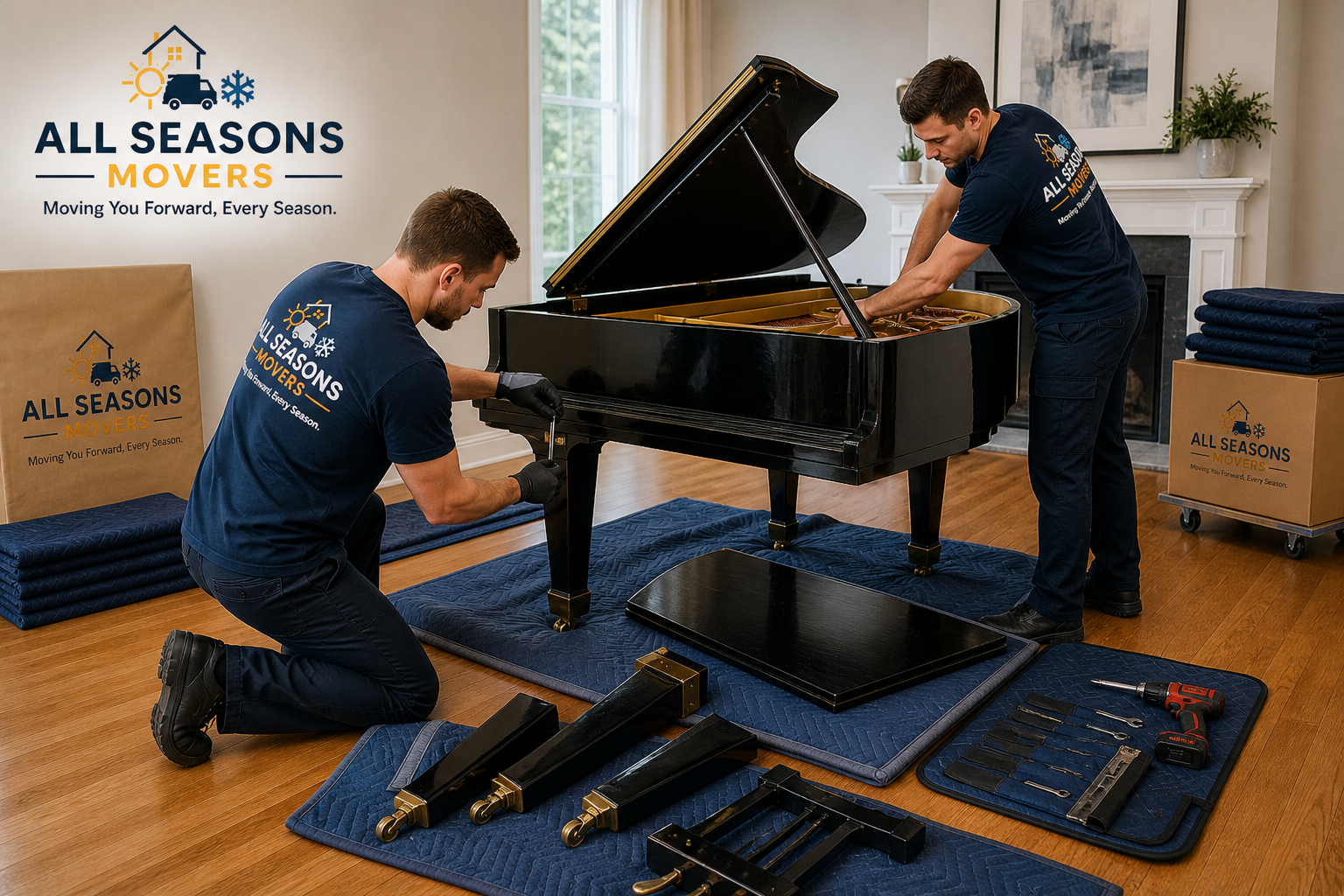
Unlike an upright piano which stays vertical throughout the entire move, a baby grand piano must be fully disassembled before it goes anywhere. The three legs come off individually. The pedal lyre — the bracket holding the sustain and soft pedals — is unbolted from the underside. The lid is removed and wrapped separately. Only then is the piano body carefully placed on its side onto a specialized skid board for transport.
Every one of those steps requires trained hands, proper tools, and a crew that has done it before. Now add a staircase to that picture.
Moving a Piano Up Stairs — Why It Changes Everything
Moving a piano up stairs — or down stairs — is the single most dangerous part of any piano relocation. Staircases introduce three variables that flat-surface moves don't have: gravity working against you, a constrained corridor with no room for error, and the need for every person on the crew to move in perfect synchronization at every single step.
A piano skid board on a flat floor can be rolled and guided with relative control. On stairs, that same skid board must be lifted, tilted to the staircase angle, and navigated step by step with zero momentum — because once a 550-lb piano starts sliding on a staircase, there is no stopping it. This is not an exaggeration. It's physics.
Professional crews use one of three methods when moving a piano up stairs, depending on the staircase configuration:
Method 1: Manual stair carry with a stair-climbing dolly
For standard straight staircases with adequate width (minimum 36"), a stair-climbing dolly with rubberized, staggered wheels grips each step individually, allowing the crew to "walk" the piano upward in controlled increments. This requires 3–4 movers — two pushing and guiding from below, one or two controlling descent resistance from above. Communication between the crew is constant and verbal at every single step.
Method 2: Piano skid board with moving straps and a ramp system
For wider staircases or shorter stair runs, a ramp system can be laid over the steps, creating a flat inclined surface the skid board can slide along with controlled rope tension. This method requires more horizontal space and is typically used in homes with broader, shallower staircase profiles rather than tight Chicago apartment building staircases.
Method 3: Window hoisting or crane lift
When a staircase is simply too narrow, too curved, or has too low a ceiling to allow safe passage of a baby grand piano, the instrument goes out a window or up the building exterior via a professional piano hoist. This sounds dramatic but is a well-established technique used regularly in Chicago's older neighborhoods — Lincoln Park, Old Town, Wicker Park — where vintage buildings were designed long before anyone thought about moving grand pianos through them. This method adds cost but eliminates staircase risk entirely.
The Full Step-by-Step Process: Moving a Baby Grand Piano Up Stairs
Here's exactly how a professional crew executes a baby grand piano staircase move from start to finish. Read this before hiring anyone — if your mover can't describe this process, they're not qualified.
Staircase survey and method selection
Before moving day, the crew measures the staircase: tread width, ceiling height at the lowest point, landing dimensions, and the turn radius if the staircase has a turn. Based on these measurements, they select the appropriate method — dolly, ramp, or hoist. This decision is made before moving day, not on it.
Baby grand piano full disassembly
The lid, music desk, pedal lyre, and all three legs are carefully removed. Every piece is individually wrapped in moving blankets and stretch film. The keyboard fallboard is locked or secured. The piano body is lowered onto a padded skid board, oriented bass side down.
Floor protection on the staircase
Hardwood stairs, carpeted stairs, and tile stairs all require different floor protection — rubber mats or moving pads are laid on each tread to prevent the dolly from scratching, denting, or tearing the stair surface. This step is often skipped by inexperienced movers and becomes a dispute after the move.
Crew positioning and communication protocol
The crew leader assigns positions before the piano moves an inch. Who is below, who is above, who calls each step, and what the stop signal is. With a 550-lb piano on a staircase, a miscommunication is not a mistake — it's a potential injury. Professional crews move in silence except for the crew leader's calls.
Controlled ascent — one step at a time
The piano moves upward one step at a time. Full stop at each tread. Grip check. Confirmation from all crew members. Then the next step. There is no rushing this phase. A baby grand piano moving up stairs should take 15–45 minutes for a single staircase flight depending on length and configuration.
Landing and corridor navigation
Staircase landings — especially in Chicago's vintage apartment buildings — are often the tightest point of the entire move. The piano must be rotated on the landing, sometimes only a few inches at a time, to align with the next staircase run or corridor. This is where the pre-survey measurements pay off.
Final placement and full reassembly
Once the piano reaches its destination room, the body is positioned and the skid board removed. Legs are reattached (treble side first), the pedal lyre is reinstalled, the lid and music desk are replaced, and the piano is set exactly where it will live. The crew does a final visual inspection of the instrument and the staircase before leaving.
Chicago Staircase Challenges — What Makes This City Different
Vintage building staircases
Chicago's housing stock is dominated by buildings constructed in the early-to-mid 1900s. These staircases were designed for people carrying luggage — not 550-lb musical instruments. Staircase widths in Chicago greystone buildings typically run 32"–36", which is the absolute minimum for a baby grand piano move. Low ceiling clearances at stair turns — sometimes as low as 7 feet — can make even a disassembled baby grand skid board impossible to tilt at the angle needed to navigate the turn. Always measure before booking.
Spiral and curved staircases
Spiral staircases are a complete no-go for piano staircase moves in almost every case. The turning radius is too tight for a piano skid board regardless of the piano size. If your Chicago home or building has a spiral staircase, window hoisting is the only viable option. Curved staircases (which have a gradual arc rather than tight turns) are assessed case by case — the radius of the curve determines whether a piano skid can navigate it.
Third-floor and above situations
Moving a baby grand piano to a third-floor Chicago apartment involves two full staircase runs plus two landing navigations. Each additional floor adds crew time, physical demand, and risk exposure. For anything above the second floor in a building without a freight elevator large enough for a piano skid board, experienced Chicago piano movers will often recommend the window hoist method simply because the staircase risk multiplies with each additional flight.
Cost of Moving a Baby Grand Piano Up Stairs in Chicago

Staircase moves always cost more than ground-floor moves — and they should. The additional crew coordination, time, equipment, and risk all justify a premium. Here's what to budget for in Chicago:
Your Pre-Move Checklist — Stairs, Measurements, and Preparation
Measure staircase width at the narrowest point — write it down, share it with your movers before booking
Measure ceiling height at every staircase turn and landing — this is the most commonly overlooked measurement
Note the staircase type — straight, L-shaped, U-shaped, curved, or spiral — and tell your movers exactly
Count the number of flights and total number of steps — movers price per flight, not per step
Check if the destination room door is wide enough — minimum 32" for a baby grand skid board
Clear the staircase completely on moving day — no rugs, no furniture, no decorations on walls near the staircase path
Arrange parking directly in front of the building entrance — every extra meter of carry distance adds time and risk
Photograph your staircase and send photos to your movers before moving day — this lets them plan equipment in advance
Know your building's rules — some Chicago buildings require freight elevator use or restrict moving hours
Inform your neighbors — a staircase piano move will temporarily block passage for 30–90 minutes
What If the Stairs Are Impossible? Your Alternatives
After the Move: Settling, Tuning, and Protecting Your Baby Grand
A staircase move puts more physical stress on a baby grand piano than a flat-floor move — more vibration, more tilt, more time in transit. This means post-move care matters even more than usual.
Wait a minimum of 3–4 weeks before scheduling a tuning. Your baby grand piano needs time to acclimatize to its new environment — the temperature, humidity, and airflow of its new room. Tuning too soon means it won't hold pitch and you'll need to tune again within weeks.
Position the piano away from exterior walls, heating vents, air conditioning units, and windows. In Chicago's climate especially — where winters are dry and summers are humid — these sources of environmental fluctuation will affect your piano's tuning stability and, over time, its structural health. A consistent interior wall, away from direct sunlight, is always the right choice.
After the piano has settled, have a piano technician — not just a tuner — do a full assessment. They'll check the action regulation, evaluate any movement in the pin block, and identify if the staircase move caused any internal stress. For a quality baby grand, this $100–$200 checkup is worth every penny.
Frequently Asked Questions About Moving a Baby Grand Piano Up Stairs
Can you move a baby grand piano up stairs?
Yes — but only with a professional crew trained specifically in piano staircase moves, using a piano skid board and stair-climbing dolly. It requires a minimum 36" staircase width, adequate ceiling clearance at all turns, and 3–4 experienced movers. Spiral staircases and staircases narrower than 32" typically require a window hoist alternative.
How much does it cost to move a baby grand piano up stairs in Chicago?
In Chicago, moving a baby grand piano up a single staircase flight typically costs $550–$850 total, depending on the moving company and staircase complexity. Each additional flight adds $100–$200. If a window hoist is required, add $300–$600 to the base price. Always get a written, itemized quote before booking.
How many people are needed to move a piano up stairs?
A minimum of 3 trained movers for a baby grand piano on a single staircase flight. A longer staircase run, a landing with a tight turn, or a heavier piano model requires 4. Never attempt a piano staircase move with fewer than 3 people — the physics of a 500+ lb instrument on an inclined surface demands full crew control at all times.
Do I need to disassemble a baby grand piano before moving it up stairs?
Yes — always. A baby grand piano must have all three legs, the pedal lyre, and the lid removed before any staircase move. The body is then placed on a piano skid board on its side for transport. Attempting to move a fully assembled baby grand up stairs is not possible safely — the legs would snap under lateral load and the instrument's center of gravity makes it dangerously unstable.
What if my staircase is too narrow for a baby grand piano?
If your staircase is narrower than 32" or has a spiral configuration, a window hoist is typically the safest and most practical solution. Professional piano movers who operate in Chicago are experienced with hoisting — it's more common in this city than most people think, especially in the vintage greystone and courtyard apartment buildings common in Chicago's north side neighborhoods.
Moving a Baby Grand Piano Up Stairs in Chicago? Call All Seasons Movers
Staircase baby grand piano moves are one of the most technically demanding jobs in the moving industry — and they're one of our specialties at All Seasons Movers. We've navigated Chicago's greystone walkups, its vintage courtyard buildings, its tight third-floor apartments, and its spiral-staircase situations. We know this city's buildings, and we know exactly how to get your baby grand piano where it needs to go — safely, without a scratch.
Every staircase move we take on starts with a proper assessment — measurements, method selection, equipment planning — before our crew ever touches your instrument. We don't improvise on piano moves. We plan them.