





































Hiring local commercial movers in chicago?
Local Commercial Movers: The Complete Guide to Choosing the Right Team for Your Business
Let's be honest—finding reliable local commercial movers feels like searching for a needle in a haystack. You've got your entire business operation to relocate, thousands of dollars in equipment at stake, and a timeline that can't slip. The last thing you need is a moving crew that treats your server rack like it's a box of old magazines.
I've been in the commercial moving industry for two decades, and I've seen it all. The good, the bad, and the "how did they think that was okay?" Over the years, I've learned what separates professional local commercial movers from the weekend warriors who'll wreck your business in one afternoon.
Whether you're moving a 5-person startup or a 200-employee corporate office, this guide will show you exactly how to find, vet, and hire the right team. No fluff, no sales pitch—just straight talk from someone who's been there.
By the time you finish reading, you'll know more about office moving than 95% of business owners out there. Let's get into it.
What Makes Local Commercial Movers Different From Regular Movers
Here's the first thing you need to understand: local commercial movers are NOT just residential movers who happen to take business clients.
Office moving is a completely different beast. You're not just moving furniture from Point A to Point B. You're orchestrating:
IT infrastructure relocation (servers, networks, phone systems)
Specialized equipment (medical devices, manufacturing tools, lab instruments)
Chain-of-custody protocols for sensitive documents
Minimal downtime requirements (you can't afford to be offline for a week)
Compliance considerations (HIPAA, financial regulations, data security)
Professional local commercial movers have specialized training, equipment, and insurance that residential crews simply don't possess. They understand the stakes. They know that dropping a filing cabinet is annoying, but corrupting your database is catastrophic.
When you're evaluating commercial movers chicago or any local commercial moving company, this expertise should be non-negotiable.
The True Cost of Local Commercial Movers (And What You're Actually Paying For)

Let's talk money. I know you've probably gotten quotes that made your eyes water. "Why does office moving cost so much more than moving my house?"
Fair question. Here's the breakdown:
Labor Costs: Specialized Crews Aren't Cheap
Local commercial movers employ trained professionals, not college kids making beer money. These crews have:
Certifications in equipment handling, IT relocation, and specialized moving techniques
Background checks (you're giving them access to sensitive areas)
Insurance bonding (protecting you from liability)
Years of experience (knowing how to disassemble modular furniture systems, pack servers correctly, navigate building regulations)
Expect to pay $80-$150 per hour per crew member for quality local commercial movers. A typical 3-person crew for a small office move runs $240-$450 per hour.
Equipment and Tools
Professional office movers chicago come equipped with:
Heavy-duty dollies rated for commercial equipment (not Home Depot rentals)
Server racks and climate-controlled transport
Furniture disassembly tools
Protective materials designed for electronics and machinery
Hoisting equipment for tight spaces or multi-story moves
This equipment represents $20,000-$50,000 in investment per crew.
Insurance and Liability Coverage
Here's where cheap local commercial movers cut corners. Standard moving insurance covers about 60 cents per pound. Your $8,000 server weighs 50 pounds. You see the problem.
Quality commercial movers offer:
Full replacement value coverage ($100-$500 per move)
Professional liability insurance (errors and omissions)
Workers' compensation (so you're not liable if someone gets hurt)
Project Management and Planning
The best commercial movers chicago don't just show up on move day. They provide:
Pre-move site assessments
Detailed floor plans and furniture placement diagrams
IT coordination with your tech team
Timeline development and contingency planning
Post-move support
This planning phase can add $500-$2,000 to your total cost but prevents disasters.
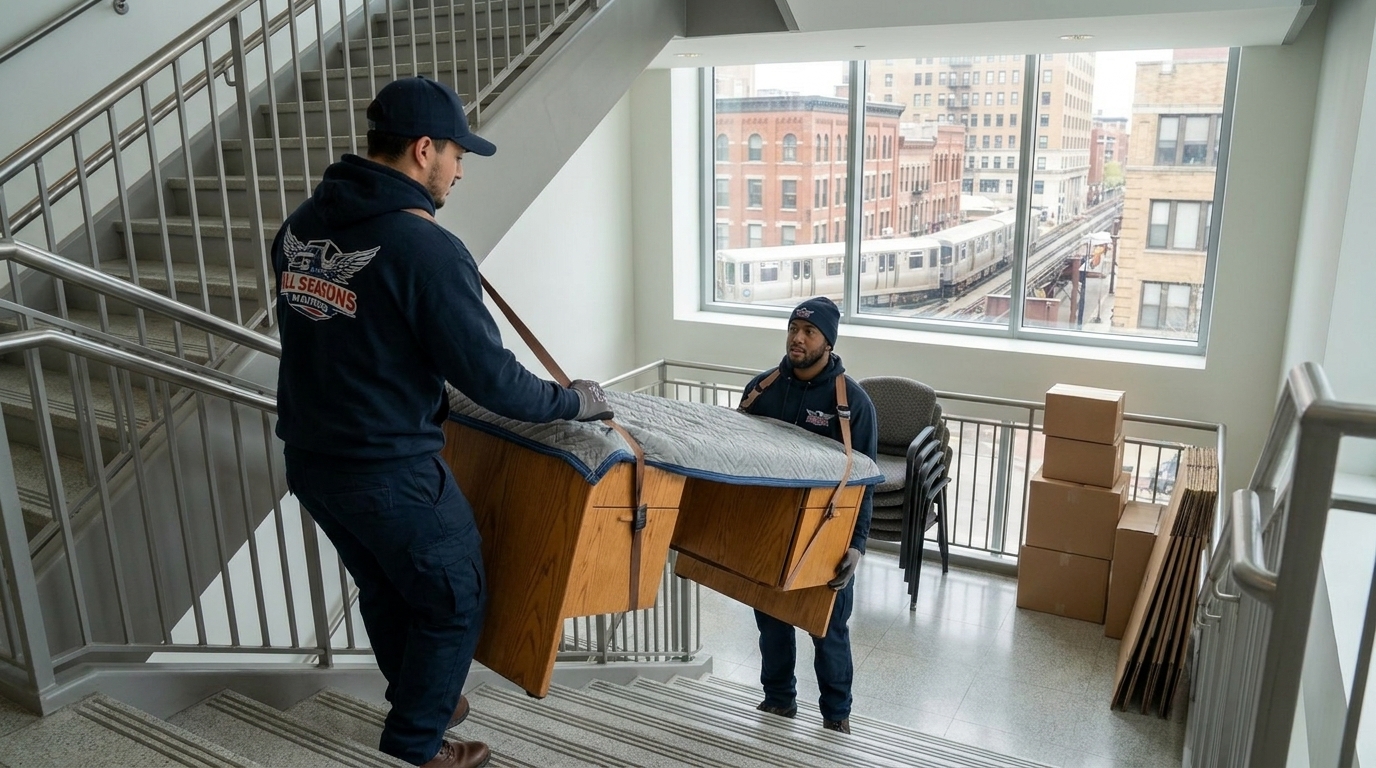
How to Find the Best Local Commercial Movers in Your Area
Alright, let's get tactical. Here's my step-by-step process for finding legitimate local commercial movers:
Step 1: Define Your Specific Office Moving Needs
Before you even Google "local commercial movers near me," sit down and document:
Total square footage you're moving
Specialized equipment that needs relocation (servers, medical devices, machinery)
Timeline and flexibility (can you move over a weekend? Do you need after-hours service?)
Distance between locations
Building constraints (elevators, loading docks, stairs, parking restrictions)
Budget range (be realistic—quality costs money)
The more specific you are, the better quotes you'll get from office movers chicago or wherever you're located.
Step 2: Research and Create a Shortlist
Don't just call the first company that pops up on Google. Here's where to look:
Professional Associations:
American Moving & Storage Association (AMSA)
International Office Moving Institute (IOMI)
Local Chamber of Commerce commercial mover members
Online Reviews (With a Critical Eye):
Google Business reviews (look for verified commercial clients)
Better Business Bureau ratings
Yelp commercial services section
Referrals:
Ask your commercial real estate broker
Contact other businesses in your building
Check with your industry association
Create a shortlist of 5-7 local commercial movers that meet basic criteria: ✓ Minimum 5 years in business ✓ Specialized commercial moving division ✓ Proper licensing and insurance ✓ Mostly positive reviews with detailed responses to complaints
Step 3: Get Detailed Written Estimates
Never, EVER hire local commercial movers based on a phone quote. Insist on:
In-Person or Virtual Site Assessments
Legitimate office moving companies will want to see your space. Red flag if they quote without seeing what they're moving.
Detailed Written Proposals Including:
Itemized cost breakdown (labor, materials, transportation, fees)
Insurance coverage details
Timeline and schedule
What's included and excluded
Cancellation and rescheduling policies
Payment terms
Get at least 3-4 competitive quotes from different commercial movers chicago providers before deciding.
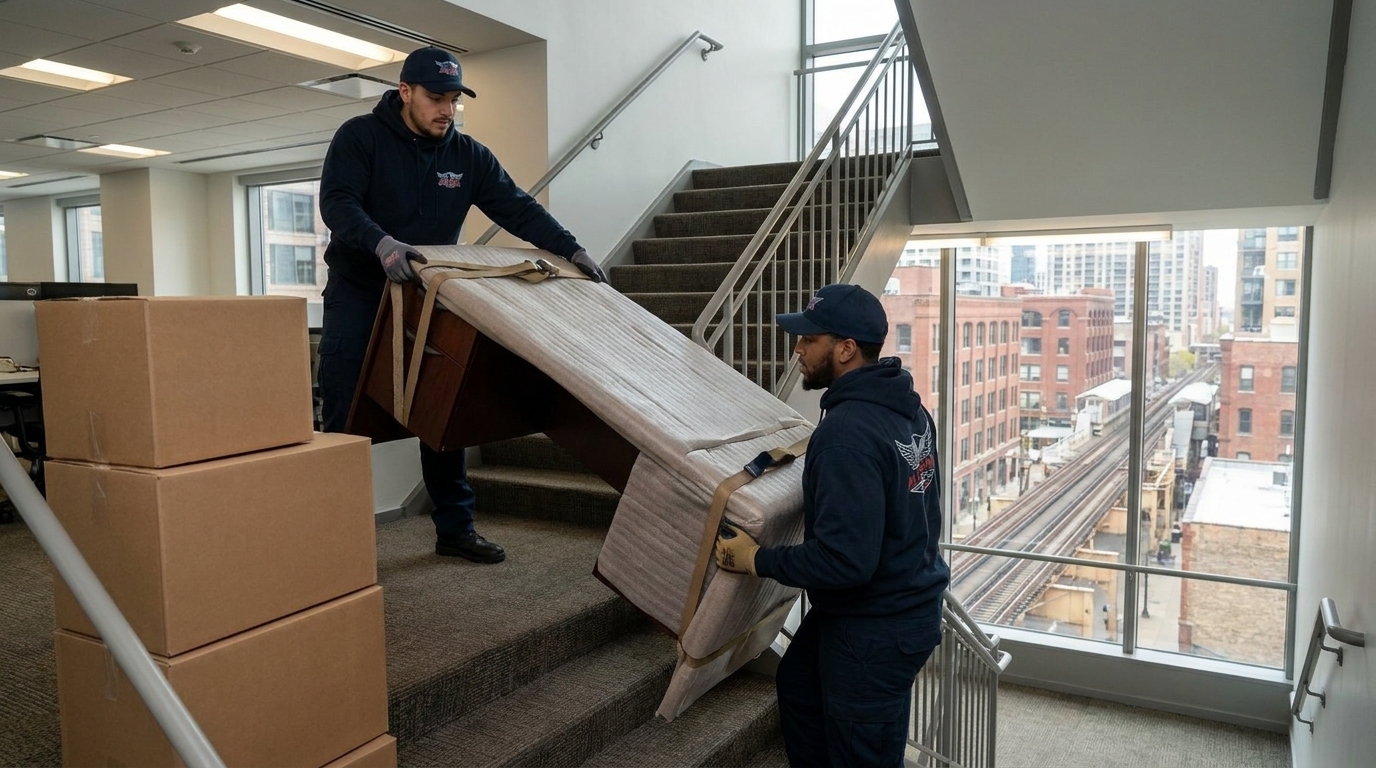
Red Flags When Hiring Local Commercial Movers
I've seen businesses get burned by sketchy movers. Here are the warning signs:
🚩 They Require Large Upfront Deposits
Reputable local commercial movers might ask for a small deposit (10-20%), but demanding 50%+ upfront is a scam indicator. You're giving them money with zero leverage.
🚩 They Don't Have Proper Insurance Documentation
Ask for certificates of insurance. If they hem and haw or say "it's in the truck," run. You need to see:
General liability insurance
Workers' compensation coverage
Commercial auto insurance
Cargo/goods coverage
🚩 Their Quote Is Significantly Lower Than Others
If everyone else quoted $5,000-$6,000 for your office moving project and one company comes in at $2,500, that's not a deal—it's a disaster waiting to happen.
Low-ball local commercial movers either:
Add hidden fees later
Use untrained labor
Lack proper insurance
Damage your equipment
🚩 No Commercial References
Any legitimate commercial moving company should happily provide 3-5 recent references from businesses similar to yours. If they "can't share client information due to NDAs," that's BS. References can verify without disclosing sensitive details.
🚩 They Don't Ask About Your IT or Specialized Equipment
Professional office movers chicago will grill you about servers, phone systems, specialized machinery. If they treat everything like "just stuff to move," they're not commercial specialists.

Questions Every Business Should Ask Local Commercial Movers
When you're interviewing potential local commercial movers, ask these questions:
About Their Experience
"How many commercial moves do you complete per month?"
You want at least 10-15 commercial jobs monthly
If they say "we do residential and commercial," push for commercial-only numbers
"Do you have experience with businesses in our industry?"
Healthcare, legal, financial services, manufacturing—each has unique requirements
Ask for specific examples
"What's the largest office you've moved?"
Helps gauge their capacity and expertise level
About Their Process
"How do you handle IT equipment and server relocation?"
Best answer: "We coordinate with your IT team and have certified technicians"
Bad answer: "We just unplug it and move it"
"What's your approach to minimizing business downtime?"
Look for detailed planning, phased moves, weekend/after-hours options
"How do you handle unexpected issues on move day?"
Professional commercial movers chicago have contingency plans
About Insurance and Liability
"What insurance coverage do you provide, and what are the limits?"
Get specifics in writing
Understand deductibles and exclusions
"What happens if equipment is damaged during the move?"
Walk through their claims process
About Costs and Contracts
"Are there any additional fees not included in this quote?"
Parking permits, elevator fees, after-hours charges, fuel surcharges
Get everything in writing
"What's your cancellation and rescheduling policy?"
Business moves sometimes need to shift—understand the penalties
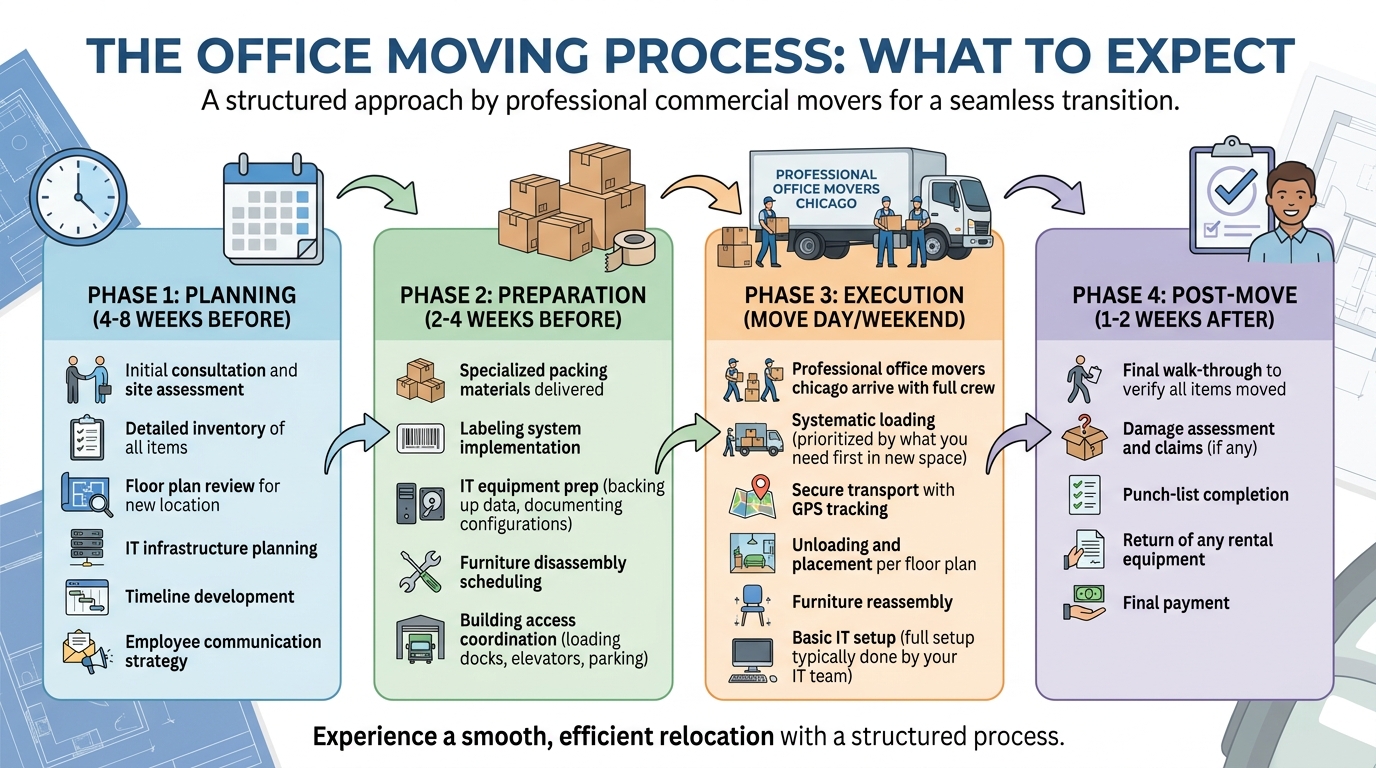
The Office Moving Process: What to Expect
Here's how professional local commercial movers typically structure an office moving project:
Phase 1: Planning (4-8 Weeks Before)
Initial consultation and site assessment
Detailed inventory of all items
Floor plan review for new location
IT infrastructure planning
Timeline development
Employee communication strategy
Phase 2: Preparation (2-4 Weeks Before)
Specialized packing materials delivered
Labeling system implementation
IT equipment prep (backing up data, documenting configurations)
Furniture disassembly scheduling
Building access coordination (loading docks, elevators, parking)
Phase 3: Execution (Move Day/Weekend)
Professional office movers chicago arrive with full crew
Systematic loading (prioritized by what you need first in new space)
Secure transport with GPS tracking
Unloading and placement per floor plan
Furniture reassembly
Basic IT setup (full setup typically done by your IT team)
Phase 4: Post-Move (1-2 Weeks After)
Final walk-through to verify all items moved
Damage assessment and claims (if any)
Punch-list completion
Return of any rental equipment
Final payment
Local vs. Long-Distance Commercial Movers: What's the Difference?
You might be wondering: "Can my local commercial movers handle a move across state lines?"
Maybe. Here's the distinction:
Local Commercial Movers:
Typically operate within 50-100 mile radius
Charge hourly rates
Same-day or next-day moves
Direct truck service (one load, one trip)
Local licensing and insurance
Long-Distance Commercial Movers:
Interstate or cross-country moves
Charge by weight and distance
Multi-day transit times
May involve warehouse storage
Federal DOT licensing required
If you're moving locally (same metro area), local commercial movers are perfect. If you're relocating to another state, look for companies with both local and long-distance capabilities or partner with a long-distance specialist.
For businesses in Chicago specifically, you'd want chicago commercial movers who understand local logistics—building regulations, parking permits, seasonal considerations (winter moves in Chicago require extra planning).
Industry-Specific Considerations for Office Moving
Different industries have unique office moving requirements:
Medical and Dental Practices
HIPAA compliance for patient records
Specialized medical equipment (X-ray machines, autoclaves)
Minimal patient care disruption
State licensing considerations
Look for local commercial movers with healthcare experience and HIPAA training.
Law Firms
Chain-of-custody for client files
Secure document handling
Library and filing system organization
Confidentiality requirements
Tech Companies
Server room relocation
Network infrastructure
Workstation setups with multiple monitors
Cable management systems
Financial Services
Regulatory compliance (SEC, FINRA)
Secure document protocols
Vault and safe moving
Minimal operational downtime
Always ask potential commercial movers chicago about their industry-specific experience.
Making Your Office Moving Day Seamless
Even with the best local commercial movers, you need to do your part. Here's my checklist:
Two Weeks Before:
[ ] Notify all employees of move timeline
[ ] Back up all data (seriously, do it twice)
[ ] Label everything according to mover's system
[ ] Confirm building access at both locations
[ ] Update your business address everywhere (Google, websites, bank, vendors)
One Week Before:
[ ] Confirm final details with office movers chicago
[ ] Test all IT equipment before disconnection
[ ] Pack personal items
[ ] Coordinate with building management
Move Day:
[ ] Designate a point person to stay with movers
[ ] Do final walk-through of old space
[ ] Document any pre-existing damage in new space
[ ] Keep essential items (keys, important docs) with you
Post-Move:
[ ] Test all systems (phones, internet, equipment)
[ ] Address issues immediately
[ ] Gather employee feedback
[ ] Leave reviews for your movers (help other businesses!)
What Great Local Commercial Movers Should Provide
Before we wrap up, let me give you a final checklist of what professional local commercial movers should offer:
✅ Detailed written estimates with no hidden fees
✅ Proof of insurance and licensing
✅ Experienced, background-checked crews
✅ Specialized equipment for commercial moves
✅ Project management and planning support
✅ IT coordination capabilities
✅ Flexible scheduling (weekends, after-hours)
✅ Transparent pricing and billing
✅ Post-move support for issues
✅ Commercial references you can verify
If your potential commercial movers chicago check all these boxes, you're probably in good hands.
Final Thoughts on Choosing Local Commercial Movers
Look, I get it. Hiring local commercial movers feels like a huge risk. You're trusting strangers with your livelihood—your equipment, your files, your ability to serve customers.
But here's the thing: the right office moving partner doesn't just move your stuff. They become part of your transition team, helping you minimize downtime, protect your assets, and start fresh in your new space without missing a beat.
Don't make this decision based solely on price. The cheapest local commercial movers usually cost the most in the long run—through damaged equipment, lost productivity, and stress that could've been avoided.
Invest in quality. Ask the tough questions. Check references. Read the fine print. And when you find a great commercial moving team, stick with them for future relocations.
Your business deserves better than a gamble. Choose office movers chicago/All Seasons Movers Chicago who treat your move like the critical business operation it is.
Ready to get quotes from local commercial movers? Start with the questions and framework in this guide, and you'll be miles ahead of businesses who just pick the first name from Google.
Good luck with your move!