






































Commercial Movers Moving Company: Why the Distinction Matters More Than You Think
Not Every Mover Can Handle Business — Here's What Makes a Commercial Movers Moving Company a Different Breed Entirely
Here's a scenario that plays out more often than any moving company will admit.
A business owner — smart, organized, running a tight ship — decides to handle the office relocation the same way they handle everything else: efficiently. They search for movers, find a highly-rated company with great reviews, book them, and assume it's handled.
Moving day arrives. The crew is friendly. They work hard. But by 11 AM, it's clear something is wrong. The server rack is sitting unprotected in the hallway. Three workstations got stacked without padding between them. The crew has no idea what "reconnection sequencing" means. And the move coordinator — who was supposed to be on-site — is managing two other jobs simultaneously from a van.
By end of day, the business has a damaged monitor, a two-day IT outage, and a very expensive lesson:
There is a fundamental difference between a moving company and a commercial movers moving company.
And that difference isn't marketing language. It's operational, it's structural, and it matters enormously when your livelihood is what's being relocated.
So What Exactly Is a Commercial Movers Moving Company?

Let's cut through the noise on this because the terminology genuinely confuses people — and moving companies don't always help by being vague about what they actually specialize in.
A commercial movers moving company is a firm that has built its entire operation around the specific demands of business relocation. Not residential moves with a commercial tier bolted on. Not a company that occasionally handles offices between apartment jobs. A company where office moving is the core competency — the thing their crews train for, their equipment is designed for, and their project management systems are built around.
The distinction matters because office moving has requirements that simply don't exist in residential work:
Chain-of-custody documentation for sensitive records and equipment
IT infrastructure handling that requires specific knowledge — not just strong backs
Coordination with property managers, freight elevator schedules, and loading dock permits
Business continuity planning so your team loses minimal operational time
Liability structures that account for commercial-grade equipment values
A residential mover can move your stuff. A commercial movers moving company moves your business — and understands those are two completely different responsibilities.

The Architecture of a True Commercial Moving Operation
Want to know if you're actually talking to a legitimate commercial movers moving company? Look past the website and into how they're structured. Here's what a real commercial operation looks like from the inside.
Dedicated Commercial Division
Not a checkbox on a dropdown menu — an actual separate operational division with crews who exclusively handle commercial jobs. They show up to work knowing every job today is a business, not a bedroom set.
Project Management Infrastructure
Every commercial move gets a project coordinator assigned before the quote is finalized. This person does the site survey, builds the timeline, coordinates with your building management, and is reachable — by phone, by text — throughout the entire process. The best [office movers Chicago] (internal link: office movers chicago) don't staff this role with whoever's free that day. It's a dedicated position.
Specialized Equipment Inventory
Custom computer crates. Anti-static packing materials. Server transportation dollies with vibration dampening. Floor runners and corner guards rated for commercial spaces. This equipment costs real money — which is why companies that are serious about commercial work invest in it, and companies that aren't serious don't.
Insurance at Commercial Scale
Here's where things get real. A residential moving company might carry $100,000 in cargo coverage. A legitimate commercial movers moving company operating in a major market should carry significantly more — because a single server rack, a conference room buildout, or a custom reception desk can exceed that in replacement value alone. Ask for the certificate. Look at the numbers.
After-Hours and Phased Move Capability
Businesses can't always go dark for a full moving day. The best [chicago commercial movers] (internal link: chicago commercial movers) are built to handle phased relocations — moving departments in stages, working nights or weekends, operating around your business calendar rather than their scheduling convenience.
Why Chicago Specifically Demands Commercial Expertise
If you're relocating a business anywhere in the Chicago metro area, the operational complexity goes up several notches compared to a suburban or smaller-market move. And that's where the gap between generalist movers and a true commercial movers moving company becomes most visible.
The best [chicago commercial movers] (internal link: chicago commercial movers) have navigated every quirk of this city's commercial real estate landscape:
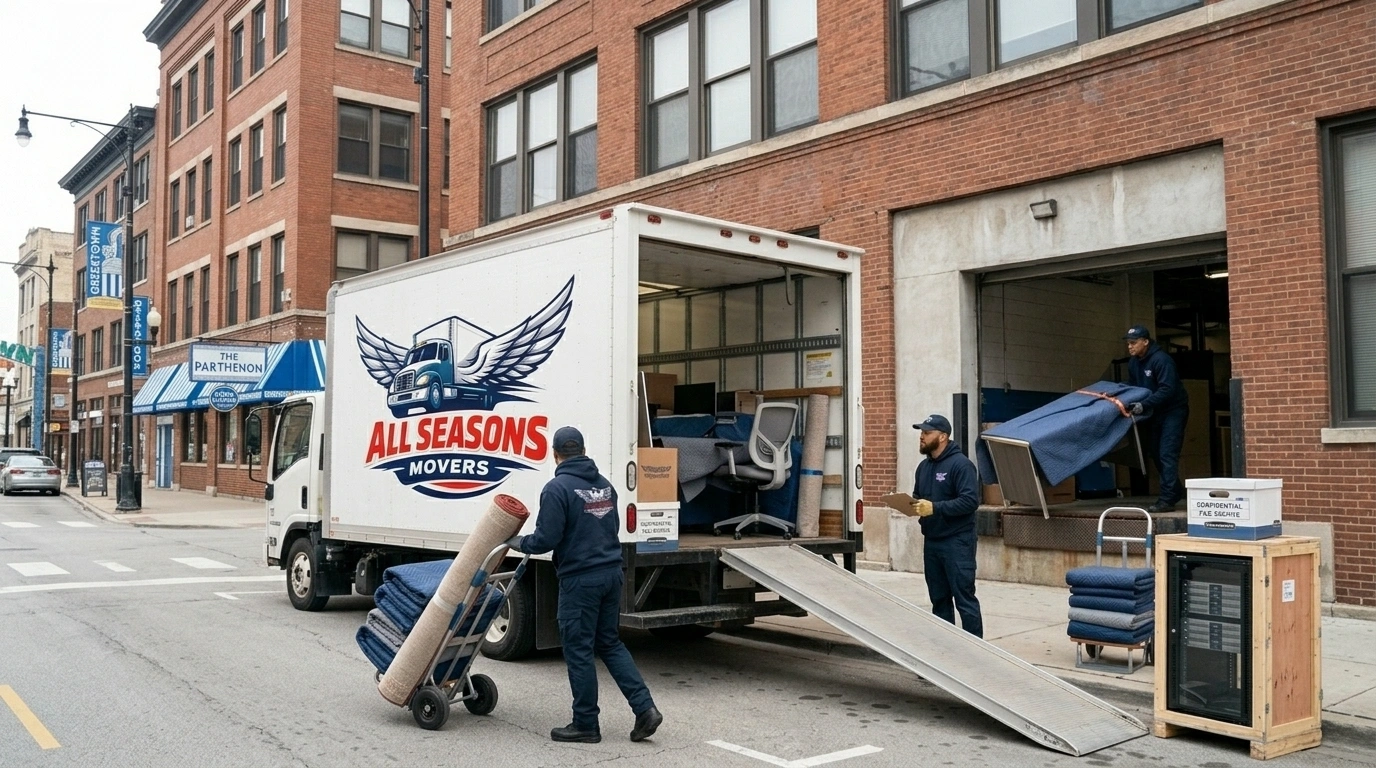
High-Rise Protocol: Moving into a building in the Loop, River North, or the West Loop isn't a matter of pulling a truck up front. It involves freight elevator reservations, certificate of insurance submissions to building management (sometimes requiring 10–14 days' notice), loading dock scheduling windows, and in some cases, union elevator operator requirements. A company that hasn't done this dozens of times will cost you an entire moving day just figuring it out.
Traffic and Access Planning: Chicago traffic is not forgiving. A commercial movers moving company with genuine city experience builds your move timeline around actual traffic realities — not GPS estimates. They know which streets to avoid at which hours, where to stage vehicles without triggering parking enforcement, and how to sequence a multi-truck move in a dense urban block.
Seasonal Variables: Chicago winters are a logistics problem in their own right. Experienced [chicago commercial movers] (internal link: chicago commercial movers) plan for weather contingencies — floor protection, equipment temperature management, accelerated loading protocols — that out-of-market or inexperienced companies simply don't account for.
The 6 Questions That Separate Real Commercial Movers From Pretenders
Before you sign any contract with a company calling itself a commercial movers moving company, run them through this filter:
1. What percentage of your annual revenue comes from commercial moves? If the answer is less than 50%, you're not talking to a commercial specialist. You're talking to a residential company that takes commercial jobs on the side.
2. Who specifically will be my project coordinator, and what is their commercial experience? Get a name. Ask how many commercial moves they've personally coordinated. Vague answers are a red flag.
3. Can you walk me through your IT equipment handling protocol? A legitimate commercial movers moving company will have a clear, specific answer. "We're careful with electronics" is not a protocol.
4. What's your cargo insurance limit, and what does it exclude? Get the certificate number. Call the insurer to verify. This is not overkill — it's due diligence.
5. Have you worked in our specific building or with our property management company before? Prior building experience isn't mandatory, but it's a significant advantage — especially in Chicago's complex commercial real estate environment.
6. What does your contingency plan look like if something goes wrong on moving day? Every professional [office movers Chicago] (internal link: office movers chicago) operation has a real answer to this. Companies winging it will fumble the question.
The Real Cost Calculation Nobody Does Before Moving Day
Most businesses evaluate moving quotes the same way: lowest number wins. But that's not actually how the math works when you factor in the full picture of office moving costs.
Consider what a bad commercial move actually costs:
IT downtime at $X per hour times the number of staff unable to work
Damage replacement for equipment not covered under a thin residential liability policy
Client impact if your systems are offline during a critical period
Staff morale and productivity lost to a chaotic, stressful moving experience
Re-moving costs if items are placed incorrectly and need to be repositioned
Now look at the quote from the legitimate commercial movers moving company again. The gap between them and the cheapest option looks very different when you're doing honest math.
Professional office moving done right is not a cost. It's a risk mitigation strategy — one that pays for itself the moment something doesn't go wrong.
What You Should Walk Away Knowing
The label "commercial movers moving company" gets used loosely. But the businesses that consistently have smooth, on-time, damage-free office relocations aren't lucky — they're just better at recognizing the real thing.
They look past the logo. They ask the hard questions. They verify the insurance. They choose a company whose entire operation is built around the specific, demanding reality of moving a business.
That's the distinction. Now you know how to find it.